What High-Performing Hotels Do Differently
High-performing hotels don’t operate in easier conditions. They face the exact same severe labor pressures, unpredictable booking volatility, relentless ownership demands, and rising guest expectations as every other property in the market. The fundamental difference lies entirely in how they choose to respond to those daily operational pressures.
Instead of managing finance, labor, operations, and physical assets as completely separate, siloed functions, top-tier properties treat them as one cohesive operating system. In this integrated environment, forward-looking forecasts directly inform labor allocations. Labor plans seamlessly inform daily operations, and those operations naturally reveal underlying asset maintenance needs. In turn, asset performance informs long-term capital planning, and performance data constantly resets the plan.
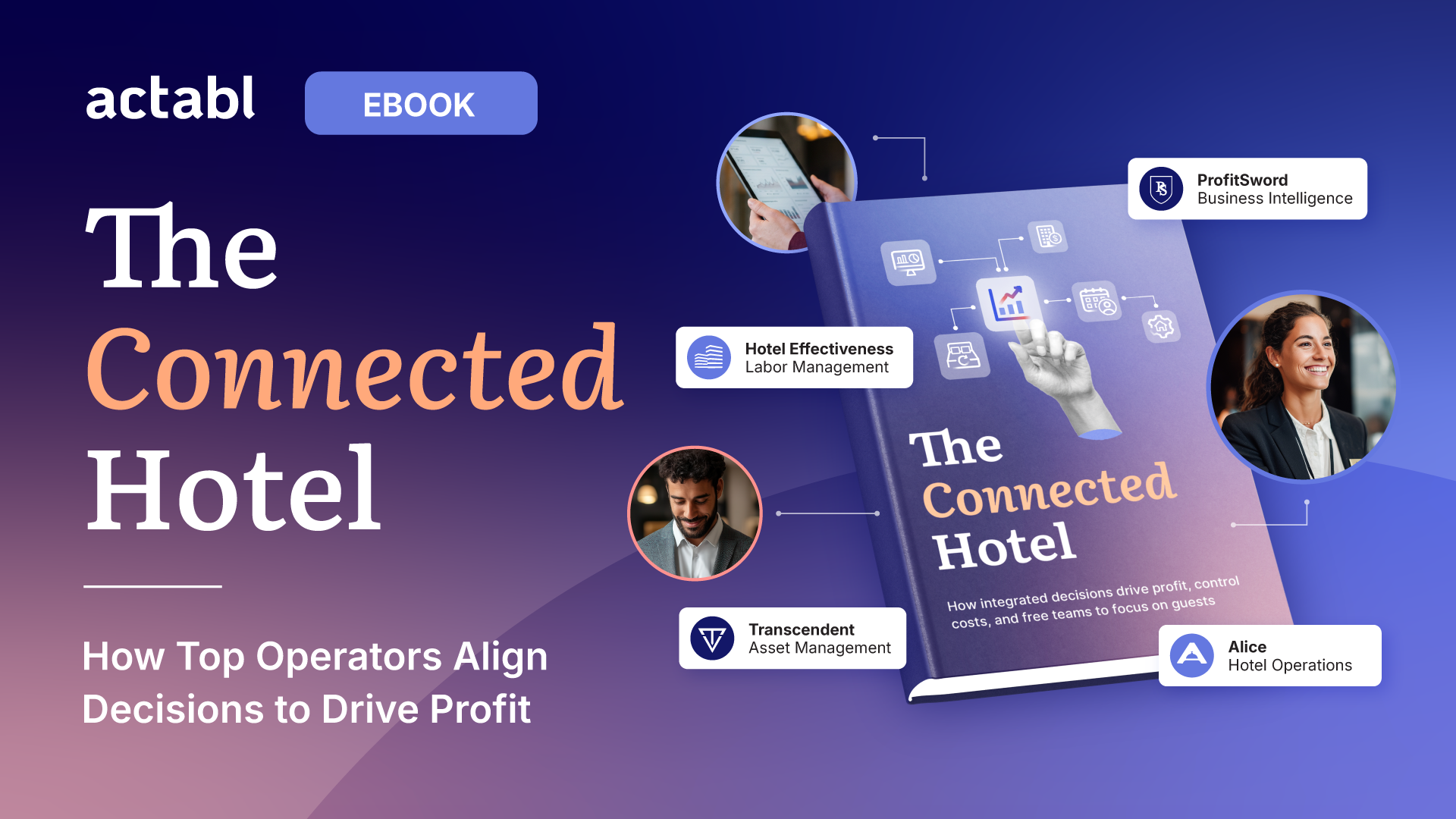
- This blog is adapted from our latest free download: The Connected Hotel eBook. Download today to explore the full framework for connecting planning, labor, operations, and asset management into one operating system for hotel performance.
The Power of Baseline Consistency
This sophisticated system depends heavily on shared visibility and consistent operational standards. David Nelson, Technical Customer Service Manager for Transcendent, Actabl’s asset management software, describes a well-run portfolio as one featuring consistent data across both the individual property and the broader enterprise. This consistency allows above-property teams to effectively manage standard operating procedures (SOPs) and brand standards across diverse regions, flags, and ownership structures, while still preserving enough autonomy for properties to adapt where localized conditions demand it. It’s all about having consistent data not just across the site but across the whole portfolio.
However, consistency doesn’t mean every single property operates as an identical clone. It simply means the organization agrees fundamentally on the baseline.
For example, an enterprise may require quarterly preventive inspections of air-handling units across all managed hotels. Meanwhile, a property situated directly on a coastal front, where heavy salt air accelerates wear and tear, may choose to conduct monthly inspections.
The standard sets the solid floor, and the property then applies its own localized intelligence.
Flexibility Versus Inconsistency
Jerimi Ford, Chief Innovation Officer at Actabl, makes a similar point regarding enterprise scale. The overarching enterprise should determine the core maintenance program, such as how frequently teams inspect guest rooms or perform preventative maintenance on ice machines, and establish which steps are standard. Legitimate variations should exist only when they are truly necessary, driven by strict jurisdictional requirements or unique, property-specific physical conditions.
“What we recommend for our partners as we go into business with them is to start out with the highest standard across the portfolio and then vary only when we need to. Maybe certain jurisdictions require inspections more frequently, certain questions to be answered, or certain logs to be kept. Because we're in thousands of locations, we've seen this a lot, and it allows us to be flexible,” he says.
This is precisely where high-performing hotels successfully separate true flexibility from chaotic inconsistency. Flexibility helps frontline teams adjust smoothly to everyday realities, whereas inconsistency forces every property to reinvent the wheel.
Strategic Alignment in Labor
The same governing principle applies directly to labor management. Labor standards provide the shared methodology, while local Managers bring essential contextual awareness regarding their specific team members, the day of the week, the local market dynamics, and the unique guest mix. Before any organization attempts to standardize its labor practices, it must achieve complete strategic alignment. Does the agreed-upon set of labor standards build the budget, or does the static budget build the labor standard? Without that foundational alignment, consistency will never hold under pressure.
- Download the Connected Hotel Self-Assessment to evaluate where your operation is connected, where it is partially connected, and where hidden friction may still be slowing decisions across planning, labor, operations, asset management, and system connectivity.
Challenging Assumptions with Connected Data
High-performing hotels also utilize connected data to actively challenge outdated assumptions. Hospitality operators must compare properties far more creatively. While traditional same-brand or same-chain-scale comparisons remain useful, they often overlook hidden operational similarities across entirely different hotel types. Two hotels sitting in completely different market segments may actually run much more alike than expected due to overlapping architectural layouts, demand mixes, staffing models, or service styles.
Achieving this level of insight requires fully connected data and leaders who can see past rigid property labels to observe how work actually happens on the floor.
Sean Finley, Senior Director of Enterprise Sales at Actabl, describes this as a train-the-trainer philosophy. Every portfolio contains properties that are crushing their metrics and others that are still learning the ropes. Without an effective vehicle for that best-in-class knowledge to move freely through the organization, tribal knowledge remains trapped at a single property. Tools can assist, but only when the enterprise builds the organizational structure to support them. As Sean states, "If there is not a vessel for that tribal knowledge to transcend from your best-in-class all the way to your bench, you are never going to succeed at the portfolio level."
As discussed in our earlier blog - The Hidden Cost of Good Enough Systems - the challenge is not just connecting disparate systems, but making sure the data they produce means the same thing once it comes together.
Turning Excellence into Discipline
Ultimately, high-performing hotels make vital knowledge completely portable. They refuse to rely on one brilliant General Manager, one exceptional Executive Housekeeper, or one veteran Chief Engineer to carry the entire weight of the system. Instead, they capture what works, standardize the process, and make it radically easier for every team across the enterprise to repeat that success. That is the true purpose of connection: transforming isolated individual excellence into sustainable, scalable operating discipline.
Download The Connected Hotel eBook to explore the full connected hotel framework and see how Actabl helps hotel teams integrate planning, labor, operations, and asset management into a single operating system for performance.