Why Your CapEx Budget Keeps Getting Blown Up
The pattern is familiar. A piece of equipment that "should have lasted longer" fails mid-season. The replacement happens on an emergency timeline, at emergency pricing, with whatever vendor is available. The capital budget takes a hit. Ownership asks questions. The team moves on to the next crisis.
Then it happens again at a different property.
If this cycle sounds familiar, the problem is not bad luck or bad equipment. It is a lack of asset history connecting daily maintenance decisions to long-term capital outcomes.
The Information Gap That Drives Reactive CapEx
In most hotel portfolios, the data needed to make strategic capital decisions exists somewhere. Install dates, repair records, warranty terms, cumulative maintenance costs. But that information is rarely centralized, consistently tracked, or connected to the moment a capital decision is being made.
Instead, replacement decisions get made in a vacuum. A property-level engineer recommends a repair because they can see the immediate problem. Corporate approves it because there is no visibility into what that asset has already cost over its lifetime. Replacement gets deferred because there is no clear signal that the asset is approaching end of life, until it fails.
Emergency procurement during peak season can cost three to four times the planned price. Across a portfolio, that multiplier turns individual equipment failures into a pattern of capital volatility that makes budgets difficult to trust.
How Transcendent Breaks the Cycle
Transcendent builds a continuous record for every asset across the portfolio:
- Install date
- Maintenance history
- Parts and labor costs
- Warranty status
- Current condition
That record changes the nature of capital decisions. Instead of evaluating each repair or replacement in isolation, operators can see the full cost trajectory of an asset and make data-informed choices about whether to continue maintaining or plan a replacement.
Patterns also become visible across properties. Similar assets in similar environments can be compared, making it easier to standardize replacement timing, identify outliers, and avoid inconsistent decisions driven by local context alone.
Capital planning shifts from reacting to individual failures to evaluating cost, risk, and timing at the portfolio level.
The Math Behind Proactive Replacement
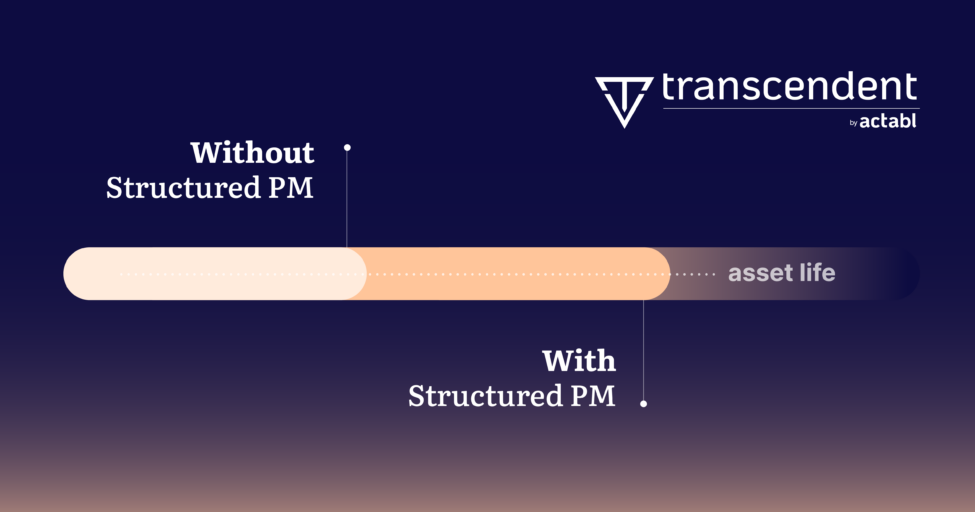
Industry research shows that structured preventative maintenance programs can extend equipment lifecycles by up to 40%. The financial impact of that extension is significant.
For a $250K chiller, extending its useful life from 15 to 20 years defers roughly $33K per year in capital expenditure for a single unit. In a 20-property portfolio with similar major assets, even modest lifecycle extensions translate into hundreds of thousands of dollars in deferred capital each year.
Those are dollars that stay in the budget for planned investments instead of getting consumed by emergency replacements.
What Changes for Ownership
The outcome is not just lower cost. It is a more predictable cost. When operators can plan replacements, justify timing with data, and show ownership a capital strategy grounded in actual asset performance, the conversation changes. Budgets gain credibility. Capital requests come with evidence. And the relationship between operator and owner shifts from explaining surprises to demonstrating stewardship.
That predictability is what protects returns and builds long-term confidence across portfolios.
This is one of seven hidden cost areas covered in our full eBook: 7 Hidden Ways Asset Management Software Is Saving Hotels Money. Download now.