
Hotel Labor Management Has a Timing Problem. Here’s How AI Insights Solves It.
The average hotel labor issue takes more than seven days to be identified. By then, overtime has already hit payroll, the scheduling gap has repeated itself three times, and the weekly ops call is about what went wrong last week rather than what’s happening now.
Meanwhile, the data that would have flagged the problem was sitting in Hotel Effectiveness the entire time.
Jenelle Hawkins, Director of Operational Excellence at Vision Hospitality Group, put it clearly: “We would try to control our labor, but you never knew what it truly was going to be until you got your actual finalized P&L. That’s a big problem when you’re trying to get ahead and control your labor from the beginning instead of afterward.”
It’s a problem that plays out across hotel portfolios every week. The data that would have flagged the issue was available the entire time. The opportunity to act on it had already passed.
That’s the gap AI Insights was built to close, starting with how a GM’s morning actually unfolds.
- Read the case study: Discover how Vision Hospitality Group reduced CPOR by $4 by connecting revenue forecasts directly to department-level staffing models.
Why labor data doesn’t translate into daily decisions
Labor is the largest controllable expense in a hotel. Ask any above-property leader, and they’ll confirm it’s a top priority. But watch how a General Manager’s morning actually unfolds, and a different picture emerges.
Before a GM opens a labor report, they’ve already handled a guest escalation, a vendor delivery, a housekeeping callout, and a message from ownership that needs a response before noon. Reviewing labor exceptions by cross-referencing schedules, actuals, forecasts, and punch data takes an experienced operator 30 to 60 minutes to do properly. That analysis is almost always the first thing that gets pushed when something more urgent comes up.
The result is a consistent pattern across the industry: labor issues get identified days after they occur, long after the window to correct them has passed.
The expertise problem that turnover is making worse
There’s a second layer to this that doesn’t get talked about enough. Even when a manager does have time to dig into labor data, knowing what to look for requires real experience.
A housekeeping overage doesn’t always mean a staffing problem. Sometimes it’s a forecasting issue. Sometimes it’s early clock-ins that have gone unaddressed for a week. Sometimes it’s a combination of both. An experienced operator reads across multiple reports and connects those dots instinctively. A manager who joined six months ago doesn’t yet know what to look for, and high turnover in hospitality means there are more of those managers in the industry than ever before.
When institutional knowledge walks out the door, labor performance goes with it. AI Insights was built with that reality in mind.
What AI Insights actually does
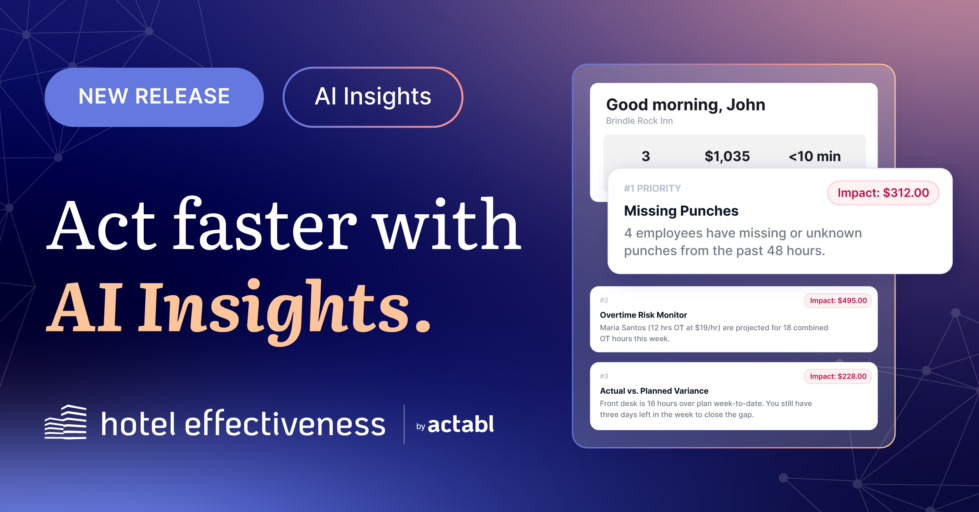
AI Insights works by reading across the labor data already in Hotel Effectiveness, like schedules, actuals, forecasts, and punch records, and surfacing what matters, in priority order, with a recommended next step attached. It delivers that guidance in two places: a daily email digest for above-property leaders that shows which properties need attention without requiring a login, and inside the Daily Labor Check-In that on-property managers are already completing every morning.
The insight isn’t just “You’re over in housekeeping.” It’s “You’re over in housekeeping because your forecast is stale and three employees clocked in 20 minutes early this week, and here’s what to do about it.”
That’s the kind of connection that used to require an experienced operator with 30 free minutes. Now it surfaces automatically every morning for every manager, regardless of experience level.
Why this matters for above-property leaders
For VPs of Operations and above-property leaders managing portfolios across multiple properties, consistency matters most. Labor performance at any given property shouldn’t depend on whether the GM has been in the industry for ten years or ten months. It shouldn’t depend on whether they had a quiet morning or a chaotic one.
AI Insights creates a consistent floor of labor decision-making across every property, every day. Above-property leaders get a portfolio-level view of where attention is needed. On-property managers get guidance that’s specific, prioritized, and actionable before the day gets away from them.
Labor management has always been too important to leave to chance. Now it doesn’t have to.
AI Insights is now live in Hotel Effectiveness. See how it works here.