
Hotel Leaders Turn to AI to Drive Financial Performance in 2026
Hotel industry performance is turning positive in 2026, until you adjust for inflation. In real terms, U.S. hotels overall are earning roughly 20 percent less than they did in 2019, and CoStar projects that gap to keep widening through 2027. Revenue is growing, but costs are growing faster.
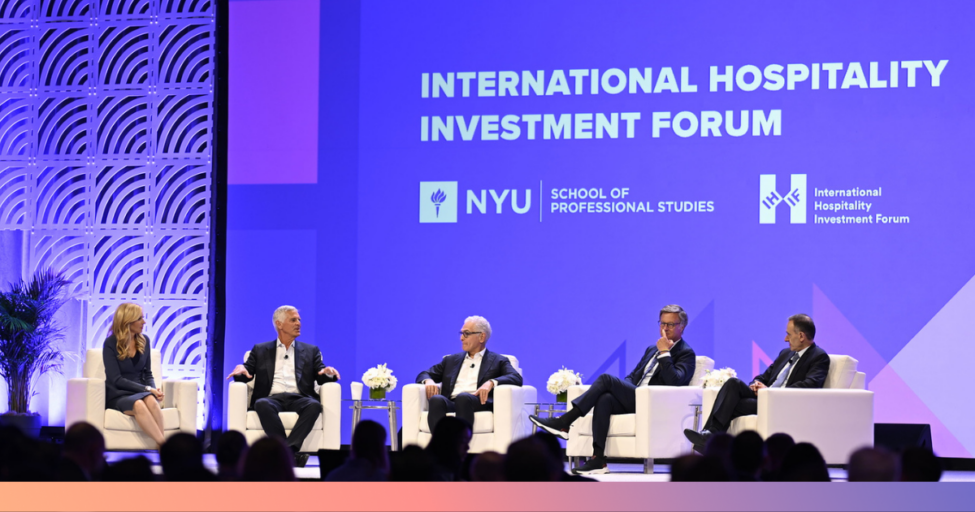
CoStar's Jan Freitag shared this in front of a packed ballroom at the 2026 NYU International Hospitality Investment Forum, and it set the tone for every AI conversation that followed. In session after session, hotel leaders discussed AI as a tool to protect profitability and drive financial performance.
Key points
- CoStar forecasts 2.8 percent RevPAR growth for 2026, but costs are rising faster than revenue, and real gross operating profit remains 20 percent below 2019. Rising costs are the problem AI is being asked to solve.
- Productive AI starts with data that is unified, accessible, and connected across operational and financial systems.
- Labor is where AI reaches the P&L first.
- The next wins are in work hotels always should have done, but never had the people to do it.
- Cost discipline came up on every stage. Hilton's CIO warned that "tokenomics is real," Loews reviews AI spend with its CFO weekly, and Host requires a business case before any tool scales.
- AI's biggest value sits in the operational core, not the visible guest-facing tools. Loews expects AI-surfaced insight to reshape leadership decision-making, and management companies that use it best gain a structural advantage.
The profit problem AI needs to solve
Freitag's 2026 U.S. forecast was revised upward, and it looks promising on the surface. RevPAR up 2.8 percent. Demand is back to positive after a negative 2025. Supply growth is just 0.4 percent, so new competition is not the issue.
Look closer, and the squeeze shows up. ADR growth of 2 percent tracks below inflation. GOPPAR is forecast to rise by just under 1 percent. As Freitag put it: "We're expecting some pricing power across the chain scales, and some margin expansion, but not enough to outpace inflation."
The pressure is coming from the cost side. Brett Horton of the American Hotel and Lodging Association relayed what owners and operators keep telling his organization: labor, their largest cost, keeps climbing, with insurance and energy right behind. Even technology itself has become a rising cost line. Andrea Grigg of CBRE Hotels noted that hotel IT costs have been increasing 35 percent a year.
Demand is providing tailwinds, with the World Cup, America's 250th anniversary, and the 2028 Olympics setting up what Robert O'Leary of the National Travel and Tourism Office described as an unprecedented decade for inbound travel. But what revenue growth alone cannot do is restore profitability. That is structural, and it's why so many at this event focused on costs and profit margins as the areas innovation with AI needs to address.
Performance with AI starts with data
Ask the hotel leaders running AI initiatives where to begin, and they start with data.
Dan Kornick, CIO of Loews Hotels, was blunt: "AI is only as good as the quality, the accessibility, and the connectedness of your data and the systems underneath." If your operational systems, guest data, and financial systems are fragmented, he told the audience, your AI output will be limited to nice-to-have insights instead of big, actionable ones.
Loews has spent years consolidating systems and technology partners to prepare for this moment, so that its teams work off the same version of truth and operational activity connects to financial outcomes. That preparation changed Kornick's philosophy on buying technology. "I'm kind of leaning towards platforms right now."
Joseph Bojanowski, President and CEO of PM Hotel Group, described the same approach across his 80-plus hotels: first get your data and distribution house in order, then turn raw data into insights, then push efficiency tools to the properties.
Labor is the first place AI reaches the P&L
Anna Scozzafava, Chief Data, AI, and Technology Officer at Choice Hotels, gave the conference its ROI test: "It has to show up in the P&L. If it doesn't show up in your P&L, there isn't an ROI." Choice is focusing its AI investment on labor productivity, embedding it in the systems operators already use. "AI should really be a practical use case, not something you're having to learn on top of what you're already doing."
Kornick pointed to the same place: "The measurable game is going to be labor efficiency because it's the easiest to track and see." Doing more with the same team. Resolving requests faster. Improving throughput. Each of those is a number that an operator can watch move.
The examples back him up. Hilton's guest messaging agent now handles 55 percent of call center chats and 36 percent of property chats, with an 88 percent customer satisfaction rate. Host Hotels has AI interactive voice response installed across the vast majority of its portfolio, and Deanne Brand, Host's SVP of Strategy and Enterprise Analytics, said it is already reducing call volumes. In both cases, hours that used to be staffed against routine requests now go to the work that needs a person.
Labor is the largest controllable cost in a hotel, so gains here move margins faster than gains anywhere else.
Put AI on the work you can't staff
On one panel about unlocking hotel NOI, Michael Mahar, SVP and Head of Commercial Technology, Digital and Loyalty Products at Wyndham Hotels and Resorts, offered one of the most useful framings of the conference. The next opportunity is not replacing work people already do. It is "getting through the types of work that people often don't have time for," he said. "I call that the human backlog." The things you want to do but never get to.
The exchange on the panel that prompted it made the point concrete. Justin Epps, Managing Director and Head of Asset Management at Barings, told the story of a West Coast property whose food and beverage margins lagged for years. The fourth general manager in three years finally found the reason: employees were swiping in for two or three shifts beyond the ones they actually worked, and nobody was checking hours against schedules to catch it. Mahar's response: checking schedules is exactly the human backlog AI can clear, because no manager gets through the day job with hours left over to audit timecards.
Grigg made the asset management version of the same point on another panel: forecasting accuracy is a constant burden on ownership, and she "cannot wait for AI to take over these forecasting tasks."
These aren't moonshots. They are backlogs of valuable work that have finally become possible to do with AI.
AI has potential, but watch the costs
The enthusiasm around AI came with a warning label. "Tokenomics is real," said Michael Leidinger, CIO of Hilton. Companies that simply told everyone to start using AI got exactly that: usage, including plenty of use cases that never needed AI at all. He compared the moment to early cloud adoption, when costs took years of optimization to tame. His fix is discipline up front: set the right goals and objectives, then be smart about the metrics and benchmarks that define success.
Kornick sees the same risk from the buyer's side. Some AI capabilities have implementation costs that exceed their ROI, which is why he reviews AI spending with his CFO every week.
Host applies the discipline before deployment. Brand said every technology investment has to improve operational efficiency, drive incremental revenue, or enhance the guest or employee experience, and it gets validated at test properties before scaling, because ultimately it is the owner's dollars on the line.
From dashboards to decisions
Panelists at the conference agreed: hotels have plenty of data, but the wins come when you can start surfacing decisions.
Kornick described the gap candidly. Loews has dashboards for everything you would ever want to know about the business. The opportunity is converting that data into timely insight. "Instead of me looking at three reports and trying to correlate information, AI should be surfacing those connections, talking it through with me, flagging anomalies quickly." He expects that shift to make a structural and strategic impact on decision-making in the hotel industry soon.
Hilton is already building a version of this for capital decisions. Leidinger described an intelligent QA tool that ingests inspection results alongside guest surveys and reviews "to really identify what things are going to make the biggest impact on customer experience and drive growth and revenue at that property." Owners get prioritized guidance on which improvements will actually move revenue, rather than a generic punch list. Scozzafava went further: the same analysis shows where owners should invest in the property from a guest experience standpoint.
The stakes are highest for hotel management companies
Near the end of his session, Kornick was asked which area of hotel operations investors underestimate when it comes to AI-driven value creation. He pointed away from the visible, customer-facing tools. "The more important factor often comes from operating at the core of the hotel: areas like labor management, service recovery, forecasting accuracy, and back office productivity." Those applications improve operations every day, he said, and the effect compounds: better decisions, better labor allocation, less waste, more consistency across properties.
He paired it with a prediction that should get every operator's attention. He does not expect AI to sway brand selection or asset acquisition, because the industry closes those gaps too quickly. Hotel management companies are different. A management company that uses AI more effectively than its competitors, he said, holds a real structural advantage.
Loews is acting on its own thesis. The plan for the coming year is to pick three high-ROI processes that span multiple systems and put AI agents to work running them end-to-end, a step only possible because the data groundwork came first. Connected data is not just how you get insights today. It is the foundation on which AI agents will run tomorrow.
For owners deciding who manages their hotels in a market where real profit keeps eroding, the operator's answer to the AI question makes a big difference.
Where to start with AI for your hotel company
The leaders on these stages at NYU IHIF were responsible for the performance of thousands of hotels, and their approach to AI was remarkably consistent. Connect your data so it lives in one place, and you have one version of the truth. Start with labor, because it is the highest controllable cost and the easiest result to measure. Then point AI at valuable work you could never staff. And tie every dollar of AI spend to a metric, because the P&L is the scoreboard.
For most owners and management companies, the data foundation is the gating step, and it is the one you do not have to build alone. Actabl connects financial, labor, and operations data on a single platform, which is exactly the starting point these leaders described. Read more about Actabl's data normalization process, then request a call with our team to learn more.
Frequently asked questions
How are hotel leaders using AI to improve financial performance in 2026?
Leaders at the 2026 NYU International Hospitality Investment Forum described AI as a tool for protecting profit margins and improving financial performance. With real gross operating profit still about 20 percent below 2019, companies like Hilton, Wyndham, Choice, and Loews are applying AI to labor productivity, back-office automation, and work that was previously too expensive to staff.
What do hotels need in place before AI delivers ROI?
Unified, connected data. Loews CIO Dan Kornick told the conference that AI is only as good as the quality, accessibility, and connectedness of the data underneath it. Fragmented operational, guest, and financial systems limit AI to surface-level insights.
Where does hotel AI show ROI first?
Labor. Loews calls it the most measurable gain because it is the easiest to track, and Choice Hotels focuses its AI investment on labor because that is what shows up in the P&L.
How are hotel companies controlling AI costs?
With goals and metrics set before deployment. Hilton CIO Michael Leidinger warned that "tokenomics is real" and compared undisciplined AI adoption to early cloud spending. Loews reviews AI costs with its CFO weekly, and Host Hotels validates tools at test properties against a three-part business case before scaling.
How will AI change hotel decision-making?
Loews CIO Dan Kornick expects a structural impact as AI converts dashboard data into timely insight, surfacing patterns and flagging anomalies instead of leaving leaders to correlate reports manually.