
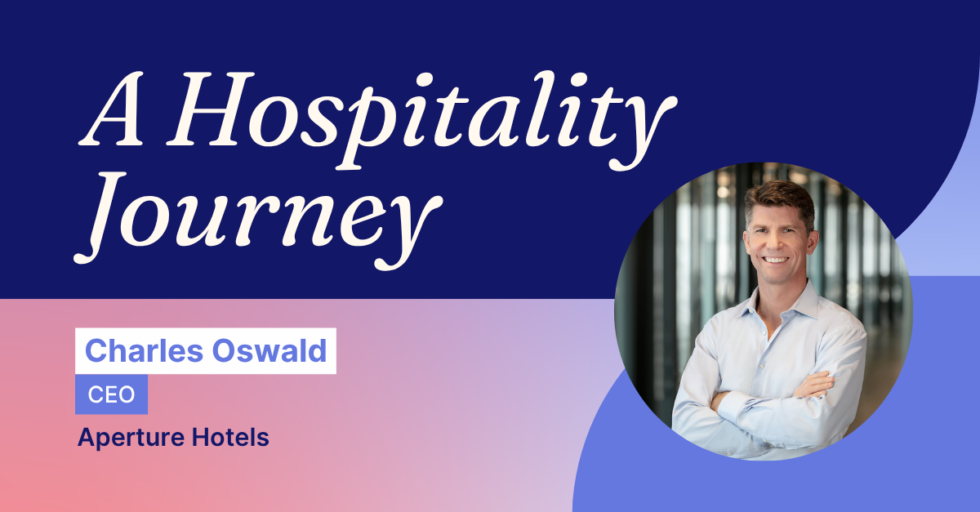
A Hospitality Journey: Ditching Wall Street for Warm Welcomes
Charles Oswald is CEO of Aperture Hotels, but his career nearly took a different turn. While working for Hyatt in college, he had his sights set on Wall Street. That was until a friend pointed out how great he had it working in hotels.
Now, he’s passing his love of hospitality onto the next generation, developing a learning management system at Aperture that invests in those who also want to climb the career ladder.
Shanell Marinuzzi, Account Manager at Actabl and former hotel GM, caught up with Charles to learn more about his career journey, dive into team development at Aperture, and get his thoughts on the opportunities and challenges ahead in 2026.
Shanell Marinuzzi Tell us a little bit about your career and what led you into hospitality.
Charles Oswald I was originally taking off with a career in finance. I had accepted a role to start with Merrill Lynch on Wall Street in a couple of weeks, when one of my buddies (who was already working at Merrill) called me up to inquire about the Hyatt, saying, "I love what you guys are doing at the Hyatt. Are you hiring?" At the time, I thought of Hyatt as a job to get me through college. I never thought about it as a career. But he got me thinking about what a great, happy place I worked in. I saw how amazing it was; businessmen laughing at the bar, dancing in the ballroom, and the opportunity to work in a lively atmosphere where we make a difference in people’s lives. So, I declined Wall Street and decided to pursue a career in hospitality.
It wasn't at all what I planned, but I tell you, it's been a wild and fun ride. I came up the hard way through operations, which led me to work with private equity, and eventually into owning my own hotel management company.
Shanell That hotel management company is, of course, Aperture Hotels. Tell us a little about that, what’s new, and what the future holds.
Charles Aperture Hotels is a third-party hotel management company. We have several compact full service and premium select service branded and independent properties. In the past couple of years, we've been shifting more into the lifestyle categories. And I tell you, it really tests our skills and creativity. We’ve been able to leverage the talent of a very experienced team to shine in that space. And we’ve seen the same thing with independents. We realized our highest year-over-year growth at our independent properties.
Shanell How is that going?
Charles Whenever we take on a new hotel, we see the highest gains in the first 12-18 months, and incremental gains thereafter. For me, this is a testament to our commercial strategy, how we optimize distribution, and how we help on-property teams manage expenses. We’ve always worked to tell the neighborhood story at these properties. And I think that has also made us successful in the lifestyle category.
Shanell Now you’re cultivating the next generation of hoteliers. You've built a culture of trust and empowerment with your team to give them growth opportunities. How have you been able to continue to build that up?
Charles It starts with casting a broad net when you're hiring. Then, narrow that down to a tight little funnel. For us, that begins with behavioral and cognitive assessments to ensure candidates can meet expectations in math, logic, verbal, and spatial thinking to be successful in leadership roles.
We know what makes people successful at Aperture. And from there, we start really matching it up to our core values and our mission. And we say, "Is this the kind of individual that's going to engender the behaviors we expect of them? And do they really embrace those values?"
One of the things that's most important for us, and is a little different than others, is that among our core values we have to be actively curious. We want people constantly discovering, scratching beneath the surface to find the hidden business opportunities that exist out there that others might not find.
Throughout the pandemic, our industry realized exceptionally high turnover, with people constantly jumping jobs for a few more bucks. Now, labor markets have stabilized a bit. We're in a little bit of a no-hire, no-fire situation, and that has its advantages. Among them is that when we're investing in our team, and they're staying with us for a longer term, we're realizing now that there are competitive gains; we're watching them come to fruition and become more productive. And so, with that in mind, we're investing in our learning management systems to help people grow their careers.
Shanell Tell us about the learning management system you’re building.
Charles The learning management system includes everything from required compliance and job-specific training to optional developmental training. For example, everyone is required to take an OSHA course. If you're going to be an MOD, you're going to have to take alcohol awareness training. But then there's that Guest Services Agent who wants to be a Front Office Manager. We say, ‘To be an FOM, here are some core requirements that are required of that role’. We see who's expressed interest, who the go-getters are, and those who are investing time. We invest time and money in making the resource available to them. And they invest time and interest; they are curious and want to develop themselves. We're willing to invest in them as much as they're willing to invest in themselves to help to create that advancement.
Shanell 2025 was a challenging year for the hotel industry. And challenges remain with rising costs and volatile demand. What have you been doing to ensure you're mitigating risk as far as the financials go?
Charles As an industry, we've just experienced four consecutive quarters of declining RevPAR. While the RevPAR outlook may be improving, we're still seeing ADR growth rates outpaced by CPI growth. So what does that imply? That spells declining EBITDA or EBITDA margins. And so, you're in a constant battle, both at the top line as well as fighting EBITDA erosion.
Some of the things we have done include cultivating creative top-line revenue strategies, such as adding new ancillary revenue streams. This may include parking, upcharges for late checkouts, and other similar options, allowing individuals to tailor their stay.
Another great opportunity for us is adding travel insurance to independent hotels. Travel insurance presents an opportunity for us to split commissions that go straight to the bottom line. It’s 100% profit. We worked out the technology through our insurance partner, and it's very easy to plug into independent booking engines.
In terms of operational expenses and controls, labor is our biggest lever. We must constantly be on the hunt for new efficiency. One good example here is we've taken on some robotic vacuum cleaners. We conducted a study across several companies and found that we can save an average of 4.5 minutes per departure room. That's a meaningful amount that quickly adds up to thousands and tens of thousands of dollars over a couple of years for these assets. We’re also evaluating robotic barista/bartenders to add services to smaller properties that may not otherwise offer an F&B service.
We’re a management company that's highly attuned to being creative and driving these top-line revenue strategies, and this resulted in 7% RevPAR index gains in the last year.
Shanell That's wonderful. It's nice to see the robotic vacuum cleaners, that's cool. What else are you doing with technology, and AI specifically?
Charles The most practical use of AI has been towards market research, examining what happened in the STAR Report, and predicting what's coming up next. We can see who's hiring, which businesses are growing, which concerts are coming to town, the holidays, when the kids are out of school, and all those things that might impact the forecast or explain what happened in the recent past.
When it comes to marketing, collateral, pitch decks, moving something from ChatGPT-5 to Canva Pro, it's so quick. Stuff that we spent hours or even days on now happens in a matter of minutes. It's incredible how much efficiency we've gained in our commercial strategy. Plugging Claude into Excel has been amazing.
AI can provide valuable insights and suggestions, but we're not ready to have AI run the business.
Shanell How is your organization changing the way it uses its data to drive decisions across revenue operations and finance?
Charles What we are looking for when it comes to data is how you discover opportunities. Point out to me what the top-performing and bottom-performing properties are doing, and let's bring that down to a line-by-line account level to see if we can replicate the top experience and prevent the bottom.
We seek out great systems that provide early warning alerts. Systems that alert us of issues so we can tackle them before they metastasize into a bad outcome. Our tech partners must offer a better way of doing things, not another thing to do.
Shanell Looking ahead, what do you see as your biggest opportunity and biggest risk for hotel performance in 2026?
Charles The biggest opportunity is going to be on the ancillary revenue side, capturing group growth, capitalizing on the FIFA World Cup, or being in the Super Bowl market. These are the things that will make or break the top line, and that's going to make all the difference in the world for us.
Second is making sure that we're increasingly attuned to labor productivity and having the right people in the right place at the right time through great demand forecasting.
The opportunity is to capitalize on and win top-line market share through TRevPAR. The challenge before us all is to control those expenses and eliminate EBITDA erosion at the bottom line in an environment where CPI is outpacing ADR growth.
- Discover how Charles and the team at Aperture Hotels implemented Hotel Effectiveness to move from manual labor tracking to a structured, portfolio-wide labor management system. Read the case study here.