The Shovel Analogy: Hotel Technology Only Works When Teams Know How to Use It
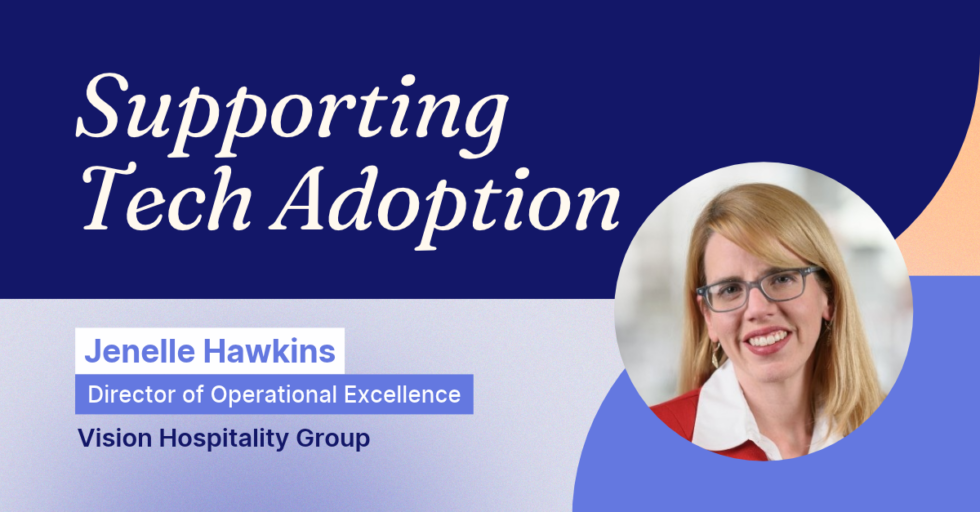
Jenelle Hawkins, Director of Operational Excellence at Vision Hospitality Group, understands all too well that hotel technology doesn't improve operations just because a hotel buys it. The difference, she says, is whether teams know how to use the tools they have.
She explains the point with an analogy she often uses when training hotel leaders: “If I said, ‘Okay, I have a job for you. I need you to dig a hole,’ and I give you a shovel to do it, why would you dig the hole with your hands?”
There’s a second part to the analogy: “If I gave you the shovel but you don’t know how to use it, why would you flip it around and try to dig the hole with the handle and not the spade?”
It is a straightforward way of describing one of hospitality’s persistent technology challenges. Buying a system solves little if managers continue working around it, lack confidence using it, or revert to familiar manual processes.
Jenelle leads company-wide training initiatives and oversees Vision’s digital learning platform. Her aim is to ensure consistent operational standards across the portfolio. Tech adoption and use play a big part in supporting these standards and helping Vision to meet and exceed not only its guest expectations but also its business goals.
Build a rolling forecast
Jenelle encourages her General Managers to use a rolling forecast to better understand the challenges and opportunities ahead.
“If you do that every single day and do a rolling seven days out, you’re going to be dealing with the most accurate information possible, and you’re going to be seeing those patterns a lot more regularly,” she says.
That gives hotel leaders a clearer view of the relationship between expected revenue, demand, and required labor.
The value is not simply producing another forecast. It is helping managers develop what Jenelle describes as a better “finger on the pulse” of the business.
That “finger on the pulse” is provided by Actabl’s ProfitSword business intelligence solution, which helps the team at Vision to identify where productivity can improve, where labor needs to increase, and when further reductions risk affecting the guest experience.
From forecast to smarter scheduling
Forecasting creates the foundation. The team at Vision then uses Hotel Effectiveness to translate that information into labor decisions.
This matters because Jenelle rejects a one-size-fits-all approach to staffing. As she explains, hotel demand doesn’t arrive in neat patterns. A property might have 100 arrivals, for example, but if 90 belong to a group checking in at 1 p.m., staffing the front desk heavily during the traditional evening shift may make little sense.
During GM training, she sees managers naturally gravitate toward traditional front desk shifts such as 7 AM to 3 PM and 3 PM to 11 PM. Her challenge to them is to reconsider those assumptions.
“We don’t have to do that anymore. You can twist it, you can change it, you can evolve with it,” she says.
Groups, local events, flight disruptions, and last-minute bookings all affect hotel demand. That requires managers to move beyond standard shift structures. A four-hour shift around peak demand might make more sense. Alternatively, an associate could work breakfast before helping with laundry. Cross-trained employees could move between functions as operational needs change.
Small productivity gains add up
The value of better forecasting and scheduling can appear small at first. One minute saved per occupied room may sound insignificant. At scale, it is anything but.
“One minute to an individual, that’s nothing, but one minute from each individual on each room every day, each week, each month, each year, look at how much productivity and how much savings that equates to,” Jenelle says.
Technology makes those differences easier to see. Earlier in her career, Jenelle calculated minutes per room manually. Forecasts and schedules also required far more manual work. Today, she says, hotel teams can use Hotel Effectiveness and ProfitSword to access the data quickly and make operational decisions from it.
“We can just go and click the button and check the data each day, and that’s going to lead you to make those operational decisions,” she explains.
That shift matters because the goal is not simply reducing labor hours. It is allocating labor more accurately.
Technology works when people understand why
Jenelle’s approach ultimately comes back to people. She advocates sharing operational data with associates, including measures such as minutes per occupied room, rather than keeping performance information within the management office.
“When you share the business basics with them, that's going to get them more engaged. When you show them what that minute means, that's when you're going to start to see real trackable operational change across the entire spectrum,” Jenelle says.
When employees understand what a metric means and how their work influences the wider hotel, efficiency stops being an abstract management target. It becomes something teams can participate in. That is what makes the shovel analogy so useful.
Hotels have access to technology that can improve forecasting, scheduling, and labor productivity. The next challenge is making sure managers understand the tools, trust the information, and use it consistently.
Having the shovel is only the beginning. Knowing how to use it is what gets the job done.