
Why Forecasting and Budgeting Still Break Down in Hotels
Hotel teams today often struggle with forecasting and budgeting because the process still relies on disconnected systems, static assumptions, and manual work.
Revenue changes daily. Labor needs shift by occupancy. Expenses move with demand, staffing, maintenance, and owner priorities. Yet many hotels still build budgets in one place, manage labor in another, track performance somewhere else, and wait for finance teams to reconcile the story. That delay creates risk.
As explored in our previous blog, What Is Hotel Business Intelligence and Why It Drives Profitability, the real value of hotel business intelligence isn’t more reporting. It’s faster, clearer decision-making across revenue, labor, and profitability.
Why Hotel Forecasting Breaks Down
Forecasts fail when they cannot keep up with the business.
A forecast built on last month’s data cannot help a General Manager respond to this week’s demand. A budget that lives outside the labor plan cannot guide staffing. A report that arrives after month-end can explain what happened, but it cannot help teams protect margin while there is still time to act. This is where the breakdown starts.
Hotel teams often work from different versions of the same plan. Finance sets the budget. Operations adjust labor. Revenue teams revise demand expectations. Property teams manage the day. Without one shared view, teams spend more time validating numbers than improving performance.
Actabl’s budgeting and forecasting software, ProfitSword, is designed to pull real-time data from hotel systems so teams can build multiple budgets, drill into performance records, and improve forecast and budget accuracy.
The Problem Is Not the Budget. It’s the Workflow.
Annual budgets still matter. They set a financial target for owners, operators, and property teams. But if the budget doesn’t connect to the forecast, the labor plan, and daily performance data, it becomes a static document. Teams then make decisions based on assumptions instead of current business conditions.
Let’s take labor planning as an example. When labor budgets and labor plans live in separate systems, hotel teams lose time, accuracy, and alignment. Finance sets expectations in one system, while Operations rebuilds them elsewhere. The result is an incomplete labor story that cannot scale across a portfolio.
That same issue applies across hotel forecasting and budgeting.
A strong plan needs three things:
- Real-time data
- Shared assumptions
- Clear accountability
Without those, the budget becomes a target people debate rather than a tool people use.
How Hotels Can Fix the Breakdown
Hotels can strengthen forecasting and budgeting by changing the operating rhythm. Here are four steps they can take:
- Connect the systems that shape performance. Revenue, labor, expenses, and owner reporting should not require separate manual reconciliation.
- Update forecasts often enough to guide action. A forecast should help teams decide whether to adjust labor, manage spend, or respond to shifts in demand.
- Make the budget visible to the people who influence it. General Managers and department leaders need to see how their choices affect profitability.
- Use business intelligence to turn reporting into decision support. Dashboards, commentary, daily data, and AI-powered inquiry only matter if they help teams act faster.
What Better Forecasting Looks Like
Commonwealth Hotels shows what changes when forecasting becomes part of daily operations.
Before using ProfitSword, financial and operational data often arrived too late to shape decisions. With ProfitSword active across the portfolio, Commonwealth gained real-time visibility into revenue, labor, and forecast data.
“You can see the month turn into what it’s going to be in real-time,” said Debbie Farrell, Vice President of Analysis, Commonwealth Hotels. “It’s just like balancing a checkbook. You see the money coming in, the days it comes in, and what you can or can’t spend.”
That shift matters because forecasting is not only about predicting revenue. It’s about deciding what to do next.
“When your revenue falls short or exceeds expectations, there are immediate decisions you need to make,” Farrell explained. “Can I cut labor? Should I hold off on a purchase? Or is now the time to spend while I have the revenue to support it?”
In other words, a useful forecast connects top-line movement to bottom-line action.
Why Connected Data Matters
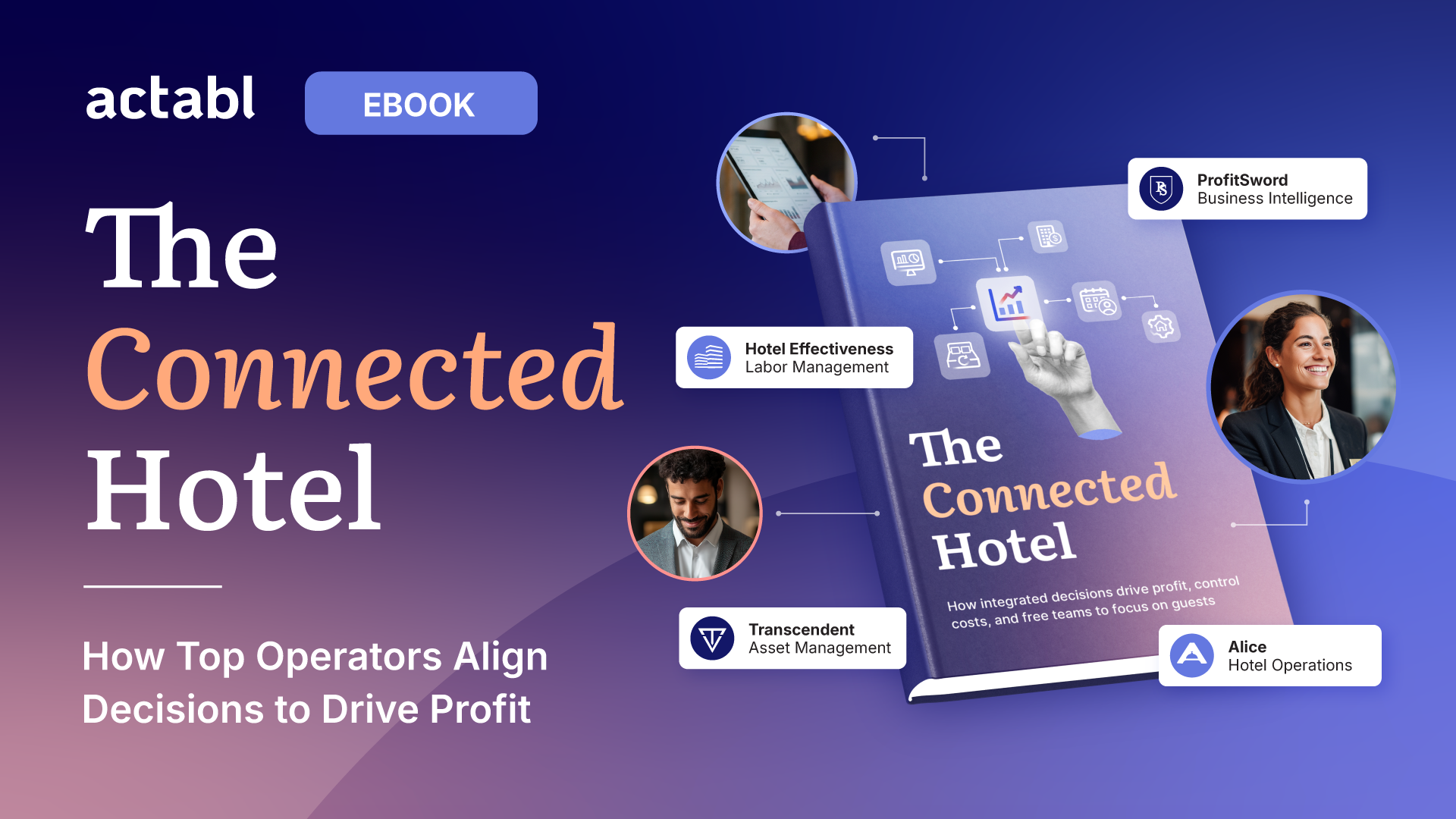
Forecasting and budgeting also break down when hotel systems don’t talk to each other. Hospitality America saw this as it planned to scale from 20 hotels to more than 40. The company had long used ProfitSword for business intelligence and later expanded to Hotel Effectiveness for labor optimization and Transcendent for engineering and asset management. The goal was to create a connected system that supported owners and associates.
“For us, it’s about streamlining. We need all these different pieces to interact with one another. We’re doing that throughout the entire environment with Actabl, from our forecasting with ProfitSword to Hotel Effectiveness and Transcendent,” said Ben Campbell, CEO, Hospitality America.
That connection gives hotel leaders a better view of how decisions interact.
Forecasting doesn’t sit solely in finance. It affects hiring, scheduling, purchasing, maintenance, and guest service. When teams can see those relationships clearly, they can make decisions earlier and with more confidence.
Where Actabl Altitude Fits In
The next step is helping hotel leaders get trusted answers faster. That’s why, in June 2026, Actabl introduced Altitude, an AI product that lets hotel executives ask questions in plain language and get answers without waiting on a report or analyst. Altitude was developed with Noble House Hotels & Resorts as a design partner and entered invite-only beta, with broader availability planned for later in 2026.
This matters because the hardest forecasting questions often come between reporting cycles. Hotel leaders want to know which properties are pacing behind forecast? Where are labor costs moving ahead of demand? And which hotels need attention before the month closes?
When data is standardized and connected, AI can help leaders move from report review to real-time inquiry. For budgeting and forecasting, that means faster access to the questions that shape performance.
What Hotel Tech Report Reviews Show
Hotel Tech Report reviewers point to the same themes: visibility, accuracy, and fewer spreadsheet handoffs.
One verified reviewer said they value ProfitSword for “accurate, reliable data,” noting that it helps teams see the full picture and create reporting that supports better decisions.
Another reviewer said ProfitSword is “easy to use, access, and work on,” adding that the copy-and-paste functionality saves time when entering information with little variance.
Hotel Tech Report also notes that hoteliers use ProfitSword to see budget, forecast, and P&L shifts without digging through multiple systems, and that large hotels use snapshots to compare actuals, budget, last year, and proforma in one place.
From Planning Exercise to Performance Discipline
Forecasting and budgeting break down when they become annual exercises instead of daily disciplines. Hotels need budgets. They also need living forecasts that reflect what is happening now.
When finance, operations, revenue, and property teams work from the same data, the conversation changes. Teams stop asking whose number is right. They start asking what action will protect performance. That is the real role of hotel business intelligence.
It gives hotel leaders the clarity to see where they are, where they are going, and what they can still change.
Explore how ProfitSword supports hotel forecasting and budgeting.