
How to Move to a Connected Hotel Operating Model
Moving to a connected operating model does not mean replacing every system in the hotel. For many operators, the bigger opportunity is to make the systems, data, workflows, and teams they already have work together more effectively.
That starts with the operation, not the technology stack. Where does information stop moving? Where do teams still export, upload, reconcile, or rekey data? Where does a manager have to wait for a report before making a decision? Where does a guest request disappear between departments? Those friction points show where connection can create the most value.
- This blog is adapted from our free The Connected Hotel eBook, which explores how hotels can connect planning, labor, operations, and asset management into one operating system for performance.
7 Practical Steps to a Connected Model
1. Map the decision flow
Document how information moves across forecasting, labor, operations, and asset planning. Then look at the decisions that information supports. What data does a manager need? Who owns it? How often does it update? What should happen when the numbers change?
Consider a hotel whose occupancy rises sharply three days before arrival. In a connected model, that change should influence labor requirements and operational planning. If someone must notice the change, download a report, email another department, and wait for somebody else to act, the workflow is still fragmented. Mapping those handoffs can reveal where valuable time gets lost.
2. Define the source of truth
Connection becomes difficult when different teams use different numbers to answer the same question. Finance may have one labor figure. Operations may have another. Property teams may maintain their own spreadsheets. Each team can believe its number is correct.
A connected model requires agreement on which system or platform owns each important metric. That does not mean putting every piece of hotel data into one application. It means teams know where to go for the trusted version of a number and understand how that information flows into other decisions.
3. Standardize the baseline
Hotel portfolios need consistency to scale. That means setting clear baseline standards for areas such as labor management, reporting, preventive maintenance, operating workflows, and performance reviews.
Without those standards, each property may develop its own way of solving the same problem. Some approaches may work well, but inconsistency makes portfolio-wide visibility and accountability harder.
Standardization gives teams a common starting point. It also makes it easier to repeat good practices across new properties and teams.
4. Protect smart property-level variation
A coastal resort may need a different preventive maintenance cadence from an inland property. Local regulations can change inspection requirements. Staffing models vary by hotel type and market. Demand patterns also differ.
A connected organization defines the baseline at portfolio level, then allows properties to adapt where there is a clear operational reason. The important distinction is between purposeful variation and accidental inconsistency.
Hotels should standardize what can be standardized, while protecting the local knowledge that helps teams respond to the realities of their property. That balance is central to the connected model.
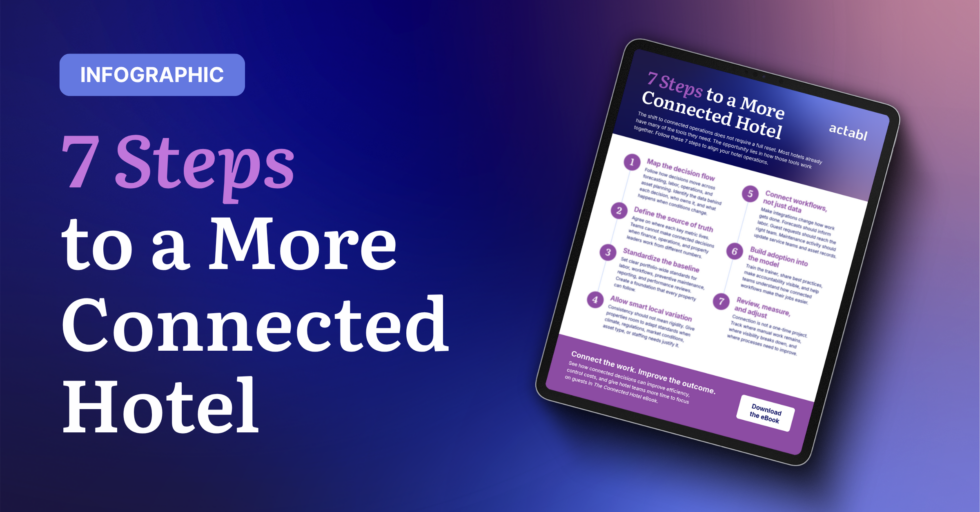
- Want the seven steps in a format you can share with your team? Download our How to Move to a Connected Model infographic.
5. Connect workflows, not just data
A forecast should influence labor planning. A guest request should reach the department responsible for resolving it. A maintenance issue should update the teams waiting for a resolution. A completed work order should strengthen the property's asset history.
This is the principle behind connected hotel operations more broadly. Forecasting, labor, operations, and asset management should form a continuous operating cycle, not a series of separate processes.
6. Build training and adoption into the operating model
Operators need people who can share best practices across properties, coach new team members, reinforce standards, and show employees how the technology makes their work easier.
Above-property support matters too. David Nelson, Technical Customer Service Manager for Transcendent, notes in The Connected Hotel that adoption tends to improve when enterprise teams provide the baseline, dashboards, structure, and accountability rather than leaving each property to build the process independently.
The technology then becomes part of the operating model, rather than another task layered onto the day.
7. Review, measure, and adjust
A connected hotel is not a finished state. Demand changes. Teams change. Properties join portfolios. Technology evolves. Workflows that made sense last year may create friction today. Hotels therefore need to keep reviewing where connection works and where manual processes remain.
Look at practical operating measures. How quickly can teams respond to a variance? How much manual reconciliation remains? Does staffing adjust as demand changes? Are departments still chasing updates from one another? Can leadership see who owns the next action?
These measures also show whether connected technology is changing hotel performance, rather than simply being implemented.
Make connected work easier
Hotel Equities offers one example of what this can look like at scale. The company invested in ProfitSword and Hotel Effectiveness as part of a move away from manual systems, siloed spreadsheets, and disconnected processes. The goal was greater visibility into forecasting, labor, performance, and budget alignment across a growing portfolio.
David Rosenberg, Executive Vice President of Operations at Hotel Equities, captures the principle behind that approach: “It gives our teams, at every level, a single source of truth.”
Hotels do not need to connect everything at once. Start where friction has the greatest operational impact. Define the source of truth. Create the baseline. Connect the workflow. Train the teams who will use it. Then measure whether decisions are becoming faster, clearer, and easier to act on.
The goal is not connection for its own sake. It is to connect the work and improve the outcome.
- Download The Connected Hotel eBook to explore the full framework for connecting planning, labor, operations, and asset management, and giving teams more time to focus on guests.