Good Hotel Data Is Hard to Get Right. Actabl Just Got a Patent for It.
Ask any finance leader at a multi-property hotel company how they get to a consolidated view of performance, and the answer usually involves a spreadsheet, someone staying late, and a nagging uncertainty about whether the numbers actually mean what they appear to mean.
It is not a data shortage problem. Hotels generate more operational data than ever — flowing in from property management systems, point-of-sale platforms, labor tools, OTA feeds, and accounting software. The problem is that none of those systems were built to speak the same language. What one platform calls "room revenue," another calls "RevRms." What one company tracks as F&B covers, another rolls into a different line entirely. When a multi-property operator tries to compare performance across 20, 40, or 200 hotels, those inconsistencies compound — and someone ends up reconciling them before the ownership call.
This is not a niche technical problem. It is one of the most persistent and expensive sources of friction in hotel portfolio management. And it is the problem Actabl has spent more than a decade building a solution for.
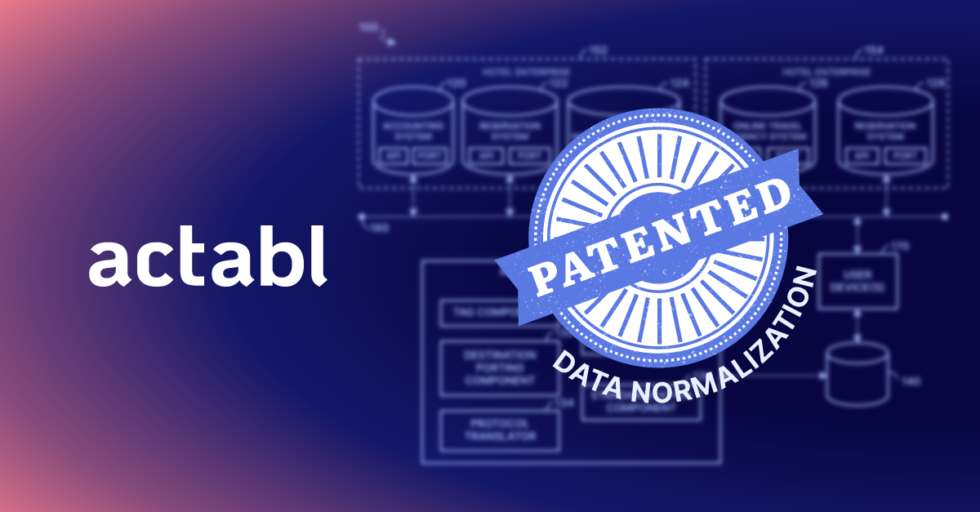
On April 14, 2026, the U.S. Patent and Trademark Office made that solution official. Actabl is the only hotel technology company to have been granted a patent by the USPTO for its unique approach to data normalization.
What the Data Problem Actually Costs Hotels
The stakes are clearer when you look at what hotel teams are doing without a reliable normalization system.
"You would have a GM putting together a daily report by hand — going through the Night Audit packet, pulling out the right pages, entering numbers into a spreadsheet, and sending it to corporate," said Clark Brayton, Senior Data Analyst at Actabl and named inventor on the patent. "Multiply that by even 100 properties. That is 200 to 300 hours of labor just to get the data in one place — before anyone can even look at it."
And that is before accounting for errors. When data is reconciled by hand across dozens of systems and properties, inconsistencies accumulate. A finance leader who cannot trust whether two properties are measuring the same metric the same way cannot make a confident decision based on that data — and cannot give ownership the clear answers they expect.
Normalized data solves this. Not just consolidated data — which is common — but data where every number means the same thing across every system, every property, every brand. That is genuinely hard to do at scale. It is also exactly what hotel leaders need to run a portfolio with confidence.
What Actabl Built — and Why It Earned a Patent
When data flows into Actabl from across a hotel's technology stack, the patented system reads the natural language inside that data, identifies what each field means, and maps it to a consistent, standardized taxonomy. The result is a single, comparable view of performance across systems and properties — one that hotel leaders and ownership groups can trust.
"The challenge was never just connecting systems," said Mike Fatal, Senior Data Engineer at Actabl and named inventor on the patent. "It was making sure the data those systems produced actually meant the same thing when you brought it all together. Two clients can use the same label for an account and be tracking completely different things. What we built makes it possible to know, confidently, that the numbers you are looking at are genuinely comparable — not just consolidated."
The normalization engine in production today is what makes Actabl's business intelligence data trustworthy. At its core is a hierarchical approach. Data coming into Actabl is first structured against each client's chart of accounts — the backbone of the system, and the relational layer that determines how data is imported, how it is reported, and how data points connect to each other.
"The chart of accounts tells the system how to import data in, how to report it out, and what data points are related to each other," said Kathryn Green, Senior Technical Product Manager at Actabl and named inventor on the patent. "Having both a dollar amount and the statistic it relates to — and having those connected — is what allows us to report across any time period and show the full picture, not just a snapshot."
On top of that sits a second normalization layer, which maps each client's accounts to a consistent, USALI-aligned taxonomy. This is what makes portfolio-level comparison possible — total room revenue for one client means exactly the same thing as total room revenue for every other client in the system, regardless of how each set up their chart of accounts.
An Integration Approach That Matches the Ambition
The normalization system is only as strong as the data going into it. That is why Actabl's approach to integrations is built around the same principle: work with what vendors have, rather than forcing them to conform to a spec.
"We tell every vendor the same thing: show us what you have and how you can provide it, and we will make it work," said Pritesh Patel, Director of Product at Actabl and named inventor on the patent. "It does not matter how the data comes in. What matters is that when it lands in Actabl, it means the same thing it means everywhere else."
That philosophy, sustained over more than a decade, has produced more than 250 active integrations — and a reputation that puts Actabl first in line when major brands transition systems. The depth of those integrations matters as much as the count. Where competitors may surface basic metrics from a PMS, Actabl pulls on-the-books data, labor data, and operational detail that makes the normalization layer genuinely useful for decision-making.
What the Machine Learning Component Adds
The patent also covers a machine learning component trained on Actabl's own hospitality data mapping history — built from the accumulated knowledge of every integration and property connection the team has made.
As that capability comes fully online, it will surface mapping recommendations based on what similar properties and systems have already done. A hotel connecting a new property using systems already in use across the portfolio will be able to move faster, with recommendations informed by every comparable setup Actabl has ever built.
"If we can give accurate recommendations during setup — drawing on everything we know from every property we have ever connected — our clients will feel that," said Fatal. "Getting set up correctly is the foundation. Everything that follows depends on it."
Why This Matters More as AI Enters the Picture
Hotel technology is moving toward AI-powered analytics — tools that surface insights, flag anomalies, and surface recommendations across portfolio data. The value of those tools depends entirely on the quality of the data underneath them.
AI applied to inconsistent, un-normalized data does not produce better intelligence. It produces faster errors.
Actabl's patented normalization system is the foundation that makes AI-powered hotel analytics trustworthy. The data in Actabl's business intelligence is not just connected — it is normalized through a process now recognized and protected by the U.S. Patent and Trademark Office. That is a meaningful difference, and one that will matter more as the industry's use of AI matures.
For hotel operators, the practical meaning is straightforward. The data you see in Actabl every morning reflects what actually happened across your portfolio — not just what each of your systems happened to call it.
Members of Actabl's engineering and product organization who are named as inventors include: Mike Fatal, Kathryn Green, Clark Brayton, Justin Call, and Pritesh Patel.
See how Actabl's data engine works for your portfolio — request a demo.