
How Hotels Used Labor Efficiency to Protect Margins in 2025
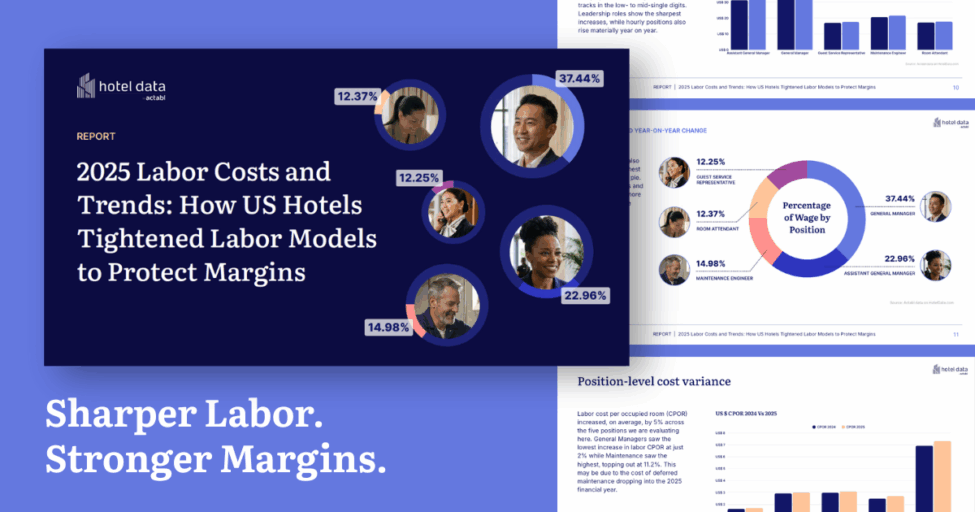
The 2025 Labor Costs and Trends Report from HotelData.com by Actabl examines how hotels navigated labor costs during the first nine months of the year. It reveals a year shaped by clear labor realities: wages remained high, forecasting accuracy mattered more than ever, and operators leaned on efficiency over headcount cuts. The data covers 5,000 hotels using Hotel Effectiveness.
US hotels entered 2025 expecting strong revenue and steady profit growth. Budgets projected rooms revenue to rise more than 14% year over year, even as ADR slipped. Operators planned for occupancy-driven growth and prepared for a year with higher labor and operating costs. By late summer, it became clear that revenue would fall short of growth expectations. Profitability now hinged on labor efficiency, not rate strategy or ambitious volume goals.
Improved Task Flow Reduced Hours
Hotels improved productivity across every major department. Guest Services hours per occupied room fell from 0.46 in January to 0.40 in September, a 13.5% reduction. Housekeeping followed a similar pattern, easing from 0.79 to 0.74 hours per occupied room. Management achieved the steepest drop, improving by nearly 15% over the same period. These gains reflect sharper forecasting, better task flow, and widespread use of labor optimization tools that aligned schedules with demand in real time.
Refined Position-level Productivity
Room attendants cut minutes per occupied room by 5.5% within the year, while general managers and assistant general managers improved by more than 14%. Guest service representatives and housepersons also saw double-digit efficiency gains. These results show that hotels did more than trim shifts. They redesigned workflows, refined service models, and made better use of every hour scheduled. Productivity improved even as wages rose by 3.7% to 5.9% year over year.
Efficiency Balanced Rising Salary Costs
Labor costs per occupied room increased, but the rise remained manageable due to stronger operational discipline. General managers posted the lowest increase in labor CPOR at 2%. Maintenance saw the highest growth at 11.2%, likely due to deferred upkeep and higher overall demand for engineering support. Housekeeping costs per room rose 9% year over year, but intra-year efficiency gains softened the impact. These patterns underline a central theme of 2025: higher wages did not guarantee higher labor costs if operators improved how and when staff worked.
Effective Scheduling Checked Overtime
Overtime provided another window into operator behavior. Hotels used overtime strategically, not reactively. Frontline roles such as room attendants and laundry attendants saw overtime shares rise, while leadership roles watched theirs decline. This suggests hotels used overtime as a flexible buffer for demand without allowing it to inflate salaried labor costs. Headcount rose 9% heading into the summer peak, then settled at a level still 4% higher than at the start of the year. Hotels rebuilt teams rather than cut them, then relied on scheduling and productivity to maintain margins.
Hotel Type Shaped Outcomes
Extended stay and select service hotels delivered the strongest labor alignment with demand. Full service hotels balanced productivity gains with broader service obligations. Resorts remained the most labor-intensive category, with hours per occupied room climbing during peak leisure months. These differences point to the value of hotel-type-specific labor forecasting for 2026.
Taken together, the data shows how operators protected margins in a softer revenue environment. They improved forecasting, reduced hours per occupied room, and extracted more value from each hour worked. They did this while paying higher wages and staffing more stable teams than in 2024.
Hotels that lead in 2026 will continue to integrate labor forecasting into business planning. The year ahead will reward operators who match labor to demand with speed, accuracy, and confidence.
- Download the full 2025 Labor Costs & Trends Report from HotelData.com to explore the complete data set and learn how to strengthen your strategy for 2026.