Why Consistency Is Harder Than Growth — and Why COOs Feel It First
The Takeaway
Growth grabs headlines. Consistency protects margins. In today’s hotel operating environment, consistency has become the harder problem, with the burden landing squarely on COOs.
After several years of recovery-driven expansion, the industry has entered a flatter, tighter phase. Demand is no longer lifting all boats. Pricing power has softened, and costs remain stubborn. The result is a new reality: leaders are judged less on how fast they grow and more on how reliably they execute. Because reliability protects not only margins but also the guest experience that drives repeat stays and long-term brand loyalty.
For COOs, that shift is personal. They sit at the intersection of labor, service delivery, asset condition, and brand standards. When performance wobbles, it shows up first in operations.
Growth Hides Problems. Flat Markets Expose Them
During growth cycles, inconsistency is easy to miss. Rising RevPAR masks labor inefficiencies. Strong demand forgives service variability. Deferred maintenance feels manageable when revenue is climbing.
That cushion is gone.
Industry forecasts tightened steadily through 2025, ending the year in negative territory for RevPAR. Occupancy declined year-on-year, while supply continued to grow. EBITDA expectations deteriorated faster than topline performance, signaling that cost-control and execution gaps, not just demand, are driving margin pressure.
In this environment, consistency doesn’t just protect margins, it protects guest satisfaction and repeat demand, which becomes harder to win when travelers have more choice.
This matters because flat demand changes the rules of performance:
- Service variability becomes a loyalty risk, not just an operational miss.
- You cannot outgrow operational drift.
- Small misses compound faster.
- Variance becomes visible to owners and the board.
Consistency becomes the real lever.
Why COOs Feel the Pressure First
When margins tighten, every function feels scrutiny. But COOs absorb it earliest and most intensely.
Operations is where strategy meets reality. Forecast assumptions turn into schedules. Budgets turn into staffing plans. Brand standards turn into daily checklists. When any of those connections break, the COO owns the outcome.
Three dynamics make consistency especially hard right now:
1. Labor assumptions built for growth no longer hold
Occupancy softness paired with modest ADR growth means labor inefficiency shows up quickly. Overstaffing erodes margins. Understaffing risks service failures. And those failures don’t just create operational noise; they create guest dissatisfaction that can weaken repeat business. Static labor models cannot keep pace with volatile demand signals.
COOs are asked to do more with fewer people, without sacrificing guest experience. That balance requires daily precision, not monthly hindsight.
2. Execution gaps widen in lean environments
Lean teams amplify operational risk: missed handoffs between departments, delayed service recovery, and preventive maintenance pushed one more week.
None of these issues look catastrophic in isolation. Together, they create inconsistency, the quiet killer of margin and brand confidence.
3. Owners want proof, not explanations
As forecasts have been revised downward, patience has thinned. Leaders are being evaluated on how early they identify issues and how consistently they deliver against plan.
COOs now need to show:
- Where execution is slipping.
- What corrective action is underway.
- How operations are protecting margin and asset value.
That requires clarity across labor, service, and assets, not anecdotes.
Consistency is an Operating System Problem
Most hotel organizations are still wired for reporting, not execution control.
Finance teams reconcile results after the fact. Operations teams manage day-to-day work in disconnected tools. Labor, service, and maintenance each optimize locally, without a shared view of performance.
In volatile environments, this fragmentation breaks down.
Consistency depends on four capabilities working together:
- Seeing pressure early across properties and departments.
- Aligning daily decisions with forecast and budget assumptions.
- Executing reliably with lean teams.
- Proving results to ownership with credible data.
Without that loop, COOs are left managing by exception and reacting after damage is done.
What Consistent Operators Do Differently
The most resilient operators are not chasing optimization. They are reducing variance.
They focus on:
- Labor alignment, not labor cuts: Staffing flexes with real demand signals, not outdated templates.
- Service reliability, not heroics: Clear ownership, fewer handoffs, and visible accountability across departments.
- Preventive discipline, not reactive fixes: Maintenance work is planned and tracked to avoid operational and capital surprises.
- Shared visibility across finance and operations: Teams work from the same data and assumptions, eliminating guesswork and finger-pointing.
This is where operational intelligence matters.
How Actabl Supports Consistency at Scale
Actabl is designed for moments like this, when growth is no longer the safety net and execution discipline determines outcomes.
Across the platform:
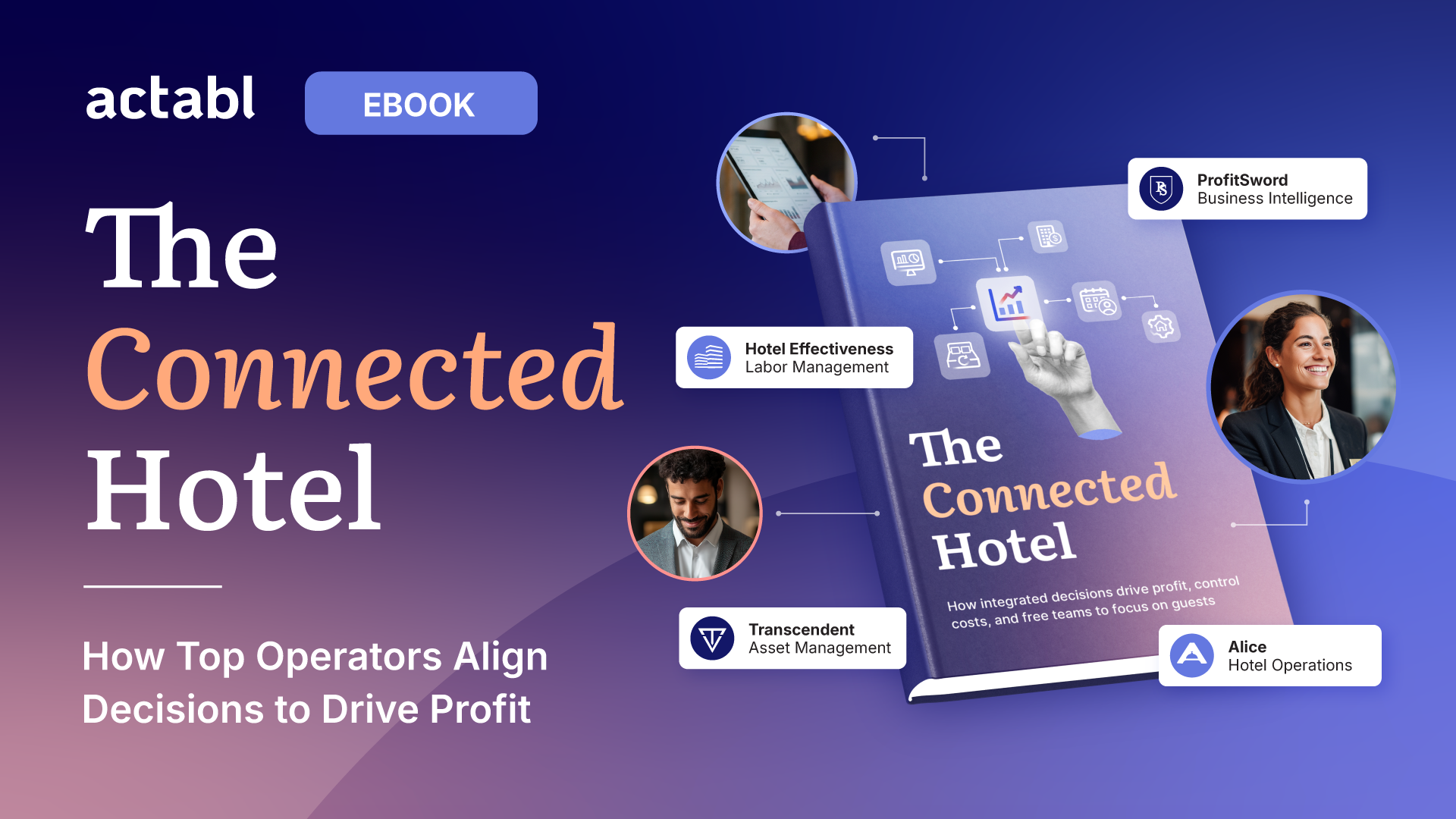
- ProfitSword gives finance and operations leaders a shared, real-time view of forecasts, pacing, and variance, so issues surface early and explanations are grounded in data.
- Hotel Effectiveness aligns staffing with actual occupancy and demand, giving COOs daily visibility into labor productivity before margins erode.
- Alice keeps service delivery consistent by coordinating tasks and communication across departments, even with lean teams, so guest requests don’t fall through the cracks.
- Transcendent connects preventive maintenance to asset planning, reducing deferred work and associated capital risk.
Together, they close the loop between insight, action, and proof, helping COOs move from reactive management to controlled execution.
The COO Mandate in 2026
The coming year will not reward aggressive forecasts. It will reward leaders who deliver predictable results in unpredictable conditions.
For COOs, that means shifting the question:
Not how fast can we grow?
But:
How consistently can we execute—property by property, week by week—when demand does not bail us out?
Consistency is harder than growth. It requires systems, discipline, and visibility. But in a flat market, it is the difference between margin erosion and margin protection.
What to Do Next
If you are responsible for operations across multiple properties, now is the moment to assess where inconsistency is creeping in, and whether your current systems help you see and correct it fast enough.
Explore how integrated visibility across finance, labor, service, and assets can help your teams execute with confidence, even when growth slows. Request a demo of the Actabl Platform today.