Beyond RevPAR: What Every Hotel CFO Should Know About GOP Flow
US hotel performance is surging in 2026, with RevPAR up 8.9%, TrevPAR up 9.2%, and GOP margin up 3.6 percentage points to 44.9%, according to HotelData's H1 Profitability Report.
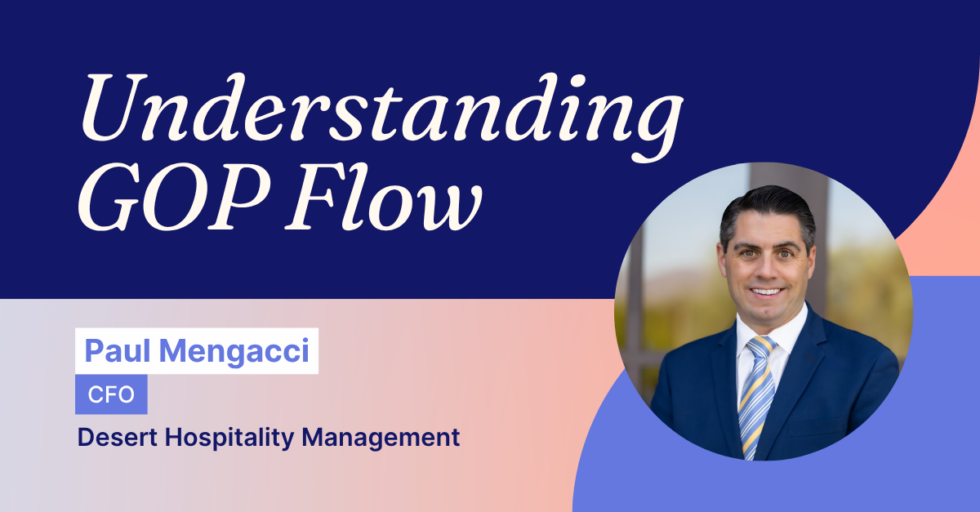
But how are hotels turning stronger demand and revenue into stronger profit? In this blog, Paul Mengacci, Chief Financial Officer of Desert Hospitality Management, unpacks how he approaches the numbers and why he's focusing on controlling labor and operating costs in 2026.
Desert Hospitality Management is a US-based hotel management company with a growing portfolio of hotels and resorts. The company works with leading brands, including Hilton, Hyatt, and Marriott.
As CFO, the first thing Paul looks for when both revenue and GOP improve, as they have in H1 2026, is GOP flow, which measures the percentage of additional revenue converted into profit.
“I want to determine if it's realistic and within the expected ranges,” he explained. “I'm also going to look for any anomalies in the numbers just to check the overall accuracy.”
A busy hotel isn't necessarily a more profitable hotel
Paul’s process is to start with the P&L summary page, then take a closer look at the room revenue mix. He wants to understand whether the revenue increase is from occupancy, rate, or both.
“If both, what was the share of occupancy growth relative to the rate growth? Because this will tell you how much additional variable costs you should expect to support this growth. So as an example, if occupancy were to stay flat and all the room revenue growth came from ADR, we should expect a much higher GOP flow percentage,” Paul explained.
After a hotel nets out franchise fees and credit card commissions, GOP flow can range between 85 and 90% because those are the only expenses that would go up with higher ADR.
However, if occupancy represents a larger share of revenue growth, variable costs for labor, supplies, etc. will increase. As such, the GOP should be lower, around the 50% range.
But it doesn’t stop there, as Paul explained: “In addition to looking at the flow in total, I'm also going to look at the totals of each individual department. I'm going to make sure the cost per occupied room is in line. The margin percentages are in line across all areas. And once all that analysis checks out, I'll feel comfortable that the results are sound, accurate, and sustainable,” he said.
Keep finance and operations aligned
During high-rate, high-demand periods, monitoring GOP flow is vital to ensure every revenue opportunity reaches the bottom line. Finance and operations teams both need to monitor the numbers. What looks like a strong performance on the surface may show a missed opportunity to boost profit even further.
“We've had hotels present their P&Ls during a monthly review, and they may be pleased with a 50% GOP flow target. But when we dig deeper into their revenue mix, we see that it was all through a high-rate period and therefore you would've expected a larger percentage to flow to the bottom line,” Paul said. “Once you start digging in, you're probably going to find opportunities on the expense side being hidden under that ADR growth.”
Conversely, if a hotel had a great month controlling expenses and bringing revenue to the bottom line, but they had a significant occupancy gain with little to no gain in ADR, that GOP flow of 50% could be a significant result.
“We want to understand the nature of the groups that are in-house, the nature of the business, and how that's going to impact costs. And regardless of which direction it goes, we want the teams to be able to tell the story of what happened in their hotel during that month, and how it lines up with the financial results,” said Paul.
Desert Hospitality Management uses ProfitSword for business intelligence that turns powerful data into actionable insights that maximize profits.
Controlling costs is mission critical
For Paul, in the current market, controlling labor and operating costs are his number one focus.
“In this environment where we're seeing margins more compressed and under more pressure, looking for those opportunities to control costs wherever possible is critical. The largest expense in the hotel is labor. So, having the tools and the processes in place to continually track labor is critical,” he said.
For Paul, this begins with an accurate forecast, and then setting up labor standards.
“Once this baseline is established, the team members can ensure that they're scheduling within those standards. But then on the backend, we want to look at that actual labor. How did that compare to the initial schedule? Did we underperform? Did we overperform? Why? What lessons can be learned? It's also critical to limit overtime wherever possible. There will be situations where overtime is needed. Call-outs, being short-staffed; it's going to happen, but it should be a last resort wherever possible, given the fact that you're paying 50% more for the same hours,” he said.
Desert Hospitality Management uses Actabl’s Hotel Effectiveness for labor management. This lets the team view labor costs collectively.
“It's an ongoing exercise. It's not set it, forget it, move on. We’re continually following up and evaluating, look at the trends, and then making the labor adjustments as needed,” said Paul.
Understanding business demand
Labor is always at the center of profitability decisions at Desert Hospitality Management. For Paul, it’s about constantly watching what business is coming through the door and adapting to it.
“Certain pieces of business are going to cost you more, and you need to know that,” he explained.
“If you've got multiple occupancy business coming in, you may need more people at the front desk. You may need more room attendants. If that’s a piece of business you've decided to accept, set up the operating model accordingly to properly support it. Don’t assume your standard baseline model will work in this case; identify what this specific business truly needs to support it.
“And it could go the other way, where you have a lot of individual business travelers that may be going directly to their rooms, working on mobile devices, and not having their rooms cleaned as often.
“But either way, don’t assume that it's one set of standards; modify it accordingly.”